

How to Style a Sideboard with a Mirror in a Classic Living Room
11/18/2026
Look into the mirror above this Modenese sideboard and the first thing you see is the opposite side of the room. Two pale curtains, gathered beneath tasseled pelmets, appear within the gold-toned frame. Below them, a lion stands in profile on a red, white-veined top. The curtains make a quiet background for its mane. It is a small relationship, easily missed in the wider view, yet it explains why the arrangement works so well.
When deciding how to style a sideboard with a mirror, begin with that view across the room. The cabinet offers a surface for objects, but the mirror adds an entirely different set of colours, shapes and lines behind them. Choosing the position of the pair is the first design decision. Choosing what to place on top can come later.
Choose a wall that gives the sideboard a role
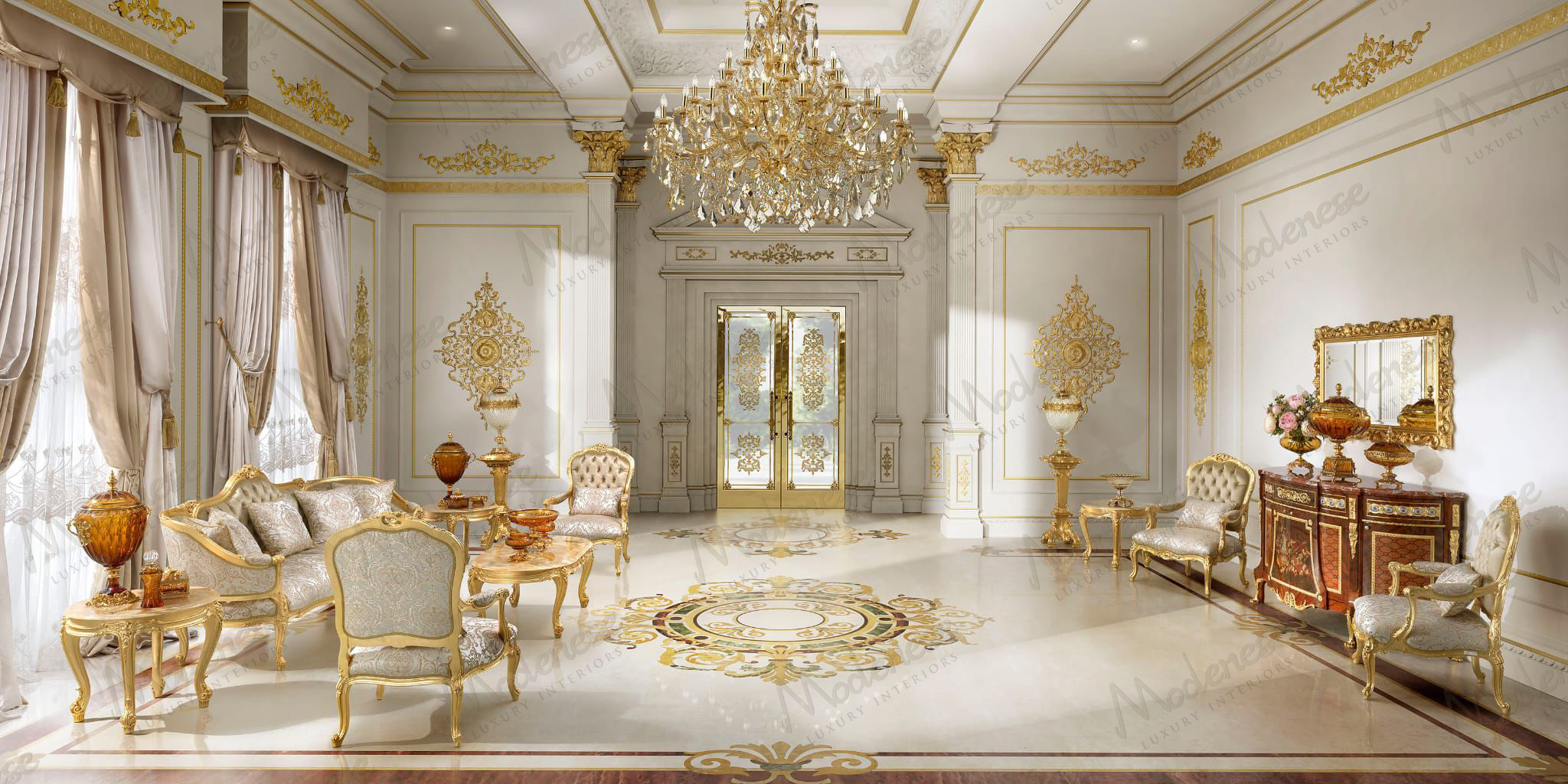
In the full view of this formal living room, the double doors hold the centre of the far wall. A chandelier marks the approach, and a circular floor motif occupies the open space in front. The sideboard stands to the right. Its dark front gives weight to that side of the room, opposite the pale sofa and tall windows, while leaving the view towards the doors open.
A side wall is worth considering in a room with a strong central feature. From the doorway, look for a position where the cabinet’s silhouette is visible. Then take a seat. A wall that seems secondary when you enter may offer the most appealing view from the sofa. Here, anyone seated by the windows can look across at the floral panel on the cabinet doors and the light caught in the frame above.
The nearby armchairs also matter. They let the cabinet belong to the seating arrangement, even though it stands apart from the main conversation group. For a smaller room, begin with the cabinet alone and add a chair only if someone can sit down, draw it forward and still leave room to reach the cabinet doors.
How wide should the mirror be above a sideboard?
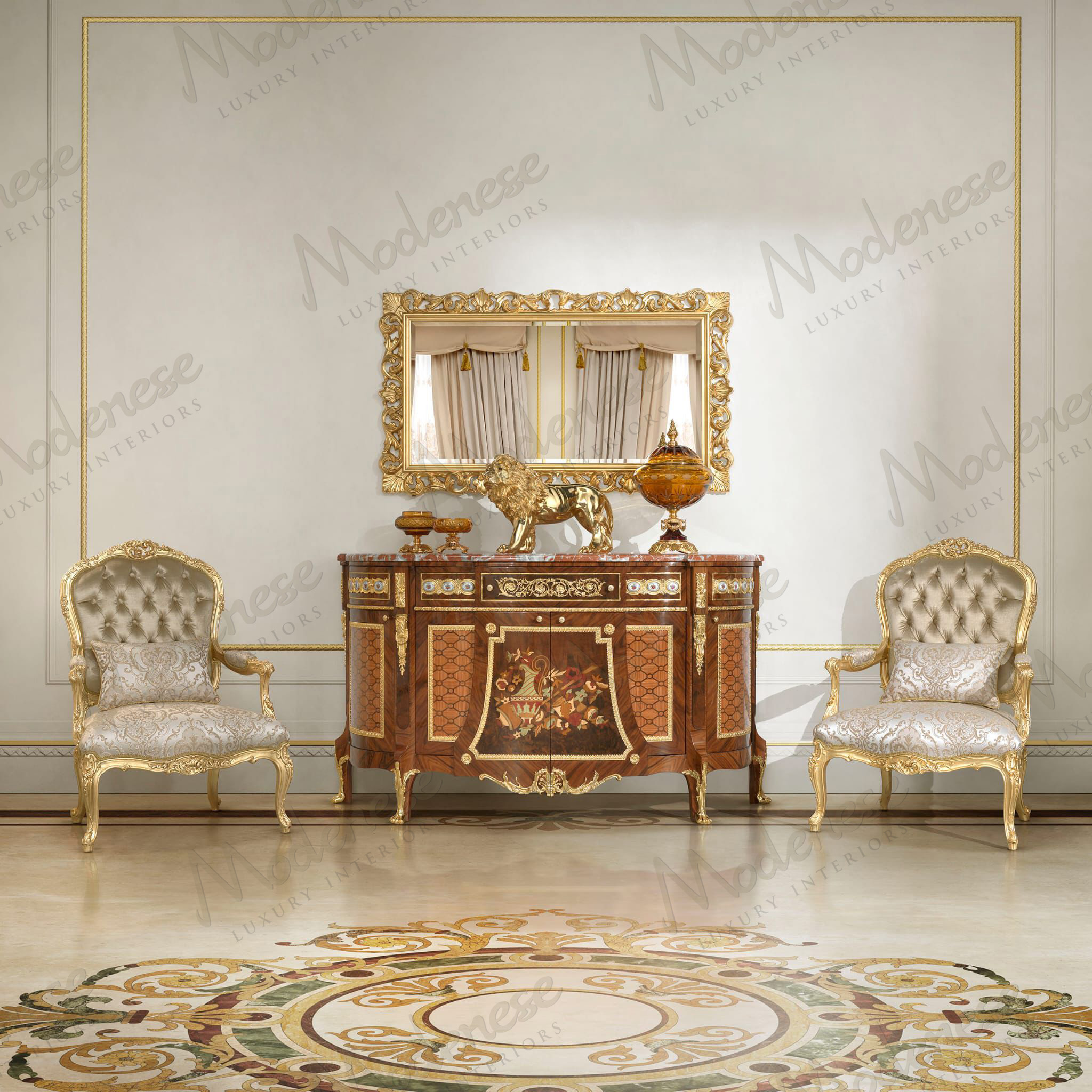
A mirror slightly narrower than the sideboard is a useful starting point. In the frontal view, the cabinet extends beyond both sides of the frame. Those short lengths of exposed top are enough to show the curve of each end and give the cabinet a distinct outline against the pale wall.
Judge the outside edge of the frame when comparing proportions. A broad frame with open scrolls occupies more wall space than its glass dimensions suggest. Here, the outermost curls are especially important. They echo the curves of the armchairs below, while the straight inner edge gives the reflected curtains a crisp rectangular border.
Check the reflection before choosing the height
Mark the proposed frame outline on the wall with low-tack tape. If possible, have someone hold a small mirror flat against the wall within that outline. Inspect the reflection from the doorway and from the seat you use most. This simple trial can reveal a cropped window, the bright underside of a light fitting or a particularly pleasing view of the opposite wall.
Next, place the tallest object you intend to display on the sideboard. In the Modenese arrangement, the lion’s head and the lid of the amber-coloured urn rise across the lower edge of the mirror. Much of the glass above them remains open. Trying the objects in place helps establish the hanging height more reliably than measuring an arbitrary gap above an empty cabinet.
Let the cabinet front guide the display
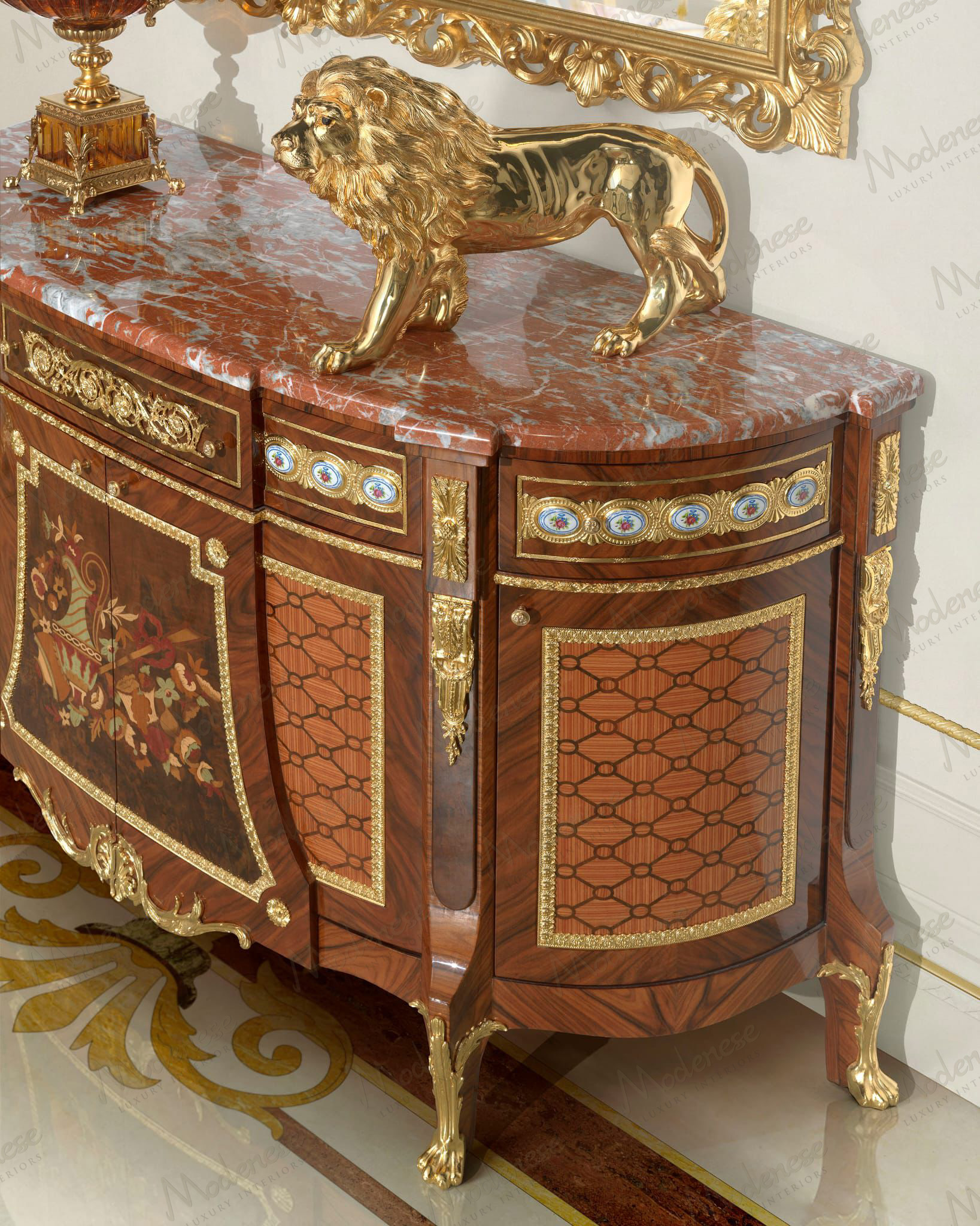
Seen close up, this sideboard already contains several scales of decoration. A floral urn motif spans the centre doors. Narrower panels carry a geometric lattice, and a row of small oval flower medallions follows the curve near the top. The red surface introduces a freer pattern of pale veins. There is a great deal to look at before a single accessory is added. The piece shown is the Flower Inlaid Masterpiece sideboard.
The frontal arrangement responds with a few legible shapes. The long body of the lion runs parallel to the top. A covered urn on the right gives the eye a higher point, while two low bowls on the left leave the lion’s face clear. Their amber colour picks up the warmer tones in the cabinet doors. Each object has a place in the composition that is apparent from the other side of the room.
For an ornate sideboard at home, start with the object you most want to see. Walk back to the opposite seat and look at its outline. If it disappears against the reflection, move it along the top before adding anything else. A sculpture can gain definition against a pale reflected curtain and lose it again a few inches away against a busy window frame. Keep some of the surface visible, particularly where a shaped edge or a change in the veining deserves a closer look.
Use the armchairs to finish the wall
In the straight-on view, a pair of button-backed armchairs frames the cabinet. Their pale upholstery sets off its darker front, and their gold-toned outlines pick up the mirror frame. The chair backs sit close to the level of the sideboard top. Together, the three pieces form a low, continuous grouping beneath a generous expanse of wall.
The symmetry of the chairs gives the objects on top a little freedom. The taller urn can stand to one side because the larger arrangement already feels settled. This is particularly helpful when styling a formal living room with pieces collected over time. A favourite vase, a sculpture and a pair of bowls can differ in height and still look at home between two related chairs.
When planning your own arrangement, look at the wall once more from the entrance. At that distance, you should be able to appreciate the cabinet’s shape and the frame above it. From the sofa, the reflection and the objects come into focus. Up close, there is the small pleasure of discovering the flowers in the medallions. Giving each distance something worth seeing is what makes this sideboard wall feel complete.
Explore Modenese’s classic Italian sideboards and credenzas to compare cabinet profiles and decorative fronts. If you are choosing a piece for a particular wall, discuss your room with Modenese. A wall elevation and a photograph taken from the opposite seat are especially useful starting points.
Related reading: The Value of Classic Italian Interiors in a Private Residence.
Related News
-

10 Tips for Choosing the Perfect Italian Dining Room
Look into the mirror above this Modenese sideboard and the first thing you see is the opposite side...
Read More -

15 Ideas Palace Design Ideas To Bring Regal Elegance To Your Home
Look into the mirror above this Modenese sideboard and the first thing you see is the opposite side...
Read More -

Modern Villa Design Ideas for Exteriors, Interiors and Pools
Look into the mirror above this Modenese sideboard and the first thing you see is the opposite side...
Read More -

7 Essential Elements to Consider When Designing a Villa
Look into the mirror above this Modenese sideboard and the first thing you see is the opposite side...
Read More -

What the Inside of a Castle Looks Like, From Great Hall to Dungeon
Look into the mirror above this Modenese sideboard and the first thing you see is the opposite side...
Read More -

The Art of the Luxury Classic Armchair: How to Transform Your Living Area into a Timeless Palace
Look into the mirror above this Modenese sideboard and the first thing you see is the opposite side...
Read More


Contact Us
Kindly provide your contact information below, and our dedicated sales team will promptly connect with you to address any inquiries.